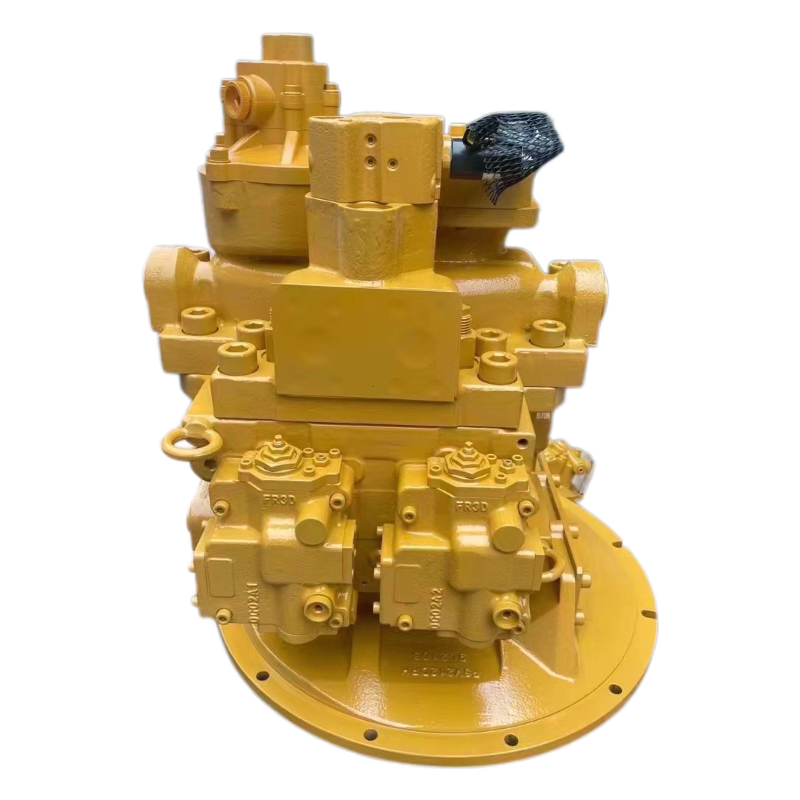
A CAT 349D hydraulic pump 497-8497 is too expensive and too central to machine performance to purchase from a model name alone. The Caterpillar parts catalog identifies 497-8497 as a double axial piston pump and lists CAT 349D and 349D2 excavator applications. The same official page also points to 20R-2045 as a Cat Reman alternative. Hongtengda’s product page additionally mentions 295-9663, but Caterpillar lists that number separately as a discontinued pump group with a wider model range. That evidence does not prove that the two numbers are universally interchangeable.
This professional guide is for fleet owners, rebuild shops, dealers and procurement teams diagnosing or sourcing a CAT 349D/349D2 main hydraulic pump. It explains how to separate pump failure from control, suction, coupling and actuator faults; how to decide between new, remanufactured and rebuild options; what to put in an RFQ; and how to inspect, install and commission the supplied unit. All pressure, flow, case-drain, torque, clearance, software and contamination limits must come from service information for the exact machine serial and pump arrangement.
What Caterpillar confirms about 497-8497
Caterpillar’s official parts store describes 497-8497 as a double axial piston pump used in the hydraulic system and lists 349D, 349D L, 349D2 and 349D2 L excavators among the compatible models. It also displays a Cat Reman alternative, 20R-2045. This first-party information supports the component type and model-family association. It does not remove the need to enter the exact machine serial, because Caterpillar warns that configuration changes can affect fitment.
The Hongtengda listing uses both 497-8497 and 295-9663 in its title. Caterpillar’s separate page for 295-9663 describes a discontinued pump group and lists 345D and 349D family applications. Because the official catalog does not present 295-9663 on the 497-8497 page as the same direct replacement, a buyer should preserve the distinction. Ask the supplier to state whether 295-9663 is the old unit number, an arrangement-specific number, a historical reference or a claimed interchange—and request the supporting serial-aware evidence.
| Identifier | Evidence available | Safe purchasing interpretation |
|---|---|---|
| 497-8497 | CAT lists a double axial piston pump and 349D/349D2 applications | Strong inquiry identifier; still verify machine serial and arrangement |
| 20R-2045 | CAT displays it as a Reman alternative to 497-8497 | Compare the exact reman scope, core rules and local availability |
| 295-9663 | CAT lists a separate, discontinued pump group for 345D/349D families | Do not assume universal interchangeability without serial-specific evidence |
Why the main pump is often blamed too early
When several functions are slow, weak or hot, the main pump becomes the obvious suspect. Yet the same symptoms can result from low oil level, aeration, suction restriction, incorrect oil, contaminated filters, a damaged drive coupling, control-signal problems, relief leakage, valve leakage, actuator bypass, cooling failure or an engine that cannot maintain commanded speed. A pump can also be damaged as a consequence of contamination or cavitation rather than being the first cause.
Replacing the pump without proving the failure leaves two risks. First, the new unit may not correct the complaint. Second, the unresolved cause may destroy the replacement. A defensible diagnosis therefore measures the system under defined conditions and uses tests that separate competing explanations. The goal is not to gather as many numbers as possible; it is to connect each measurement to a decision.
Start with machine and pump identity
Record the complete machine PIN/serial, model suffix, market configuration, engine information and relevant arrangement numbers. Photograph the machine plate and preserve the data exactly as shown. Then photograph the installed pump from several angles before cleaning or disconnection. Capture every nameplate, stamped number, casting, regulator, sensor, connector, port and drive interface.
Do not combine a machine model, a supplier title and an old invoice into one assumed identity. Mark the source of every identifier. For example: “497-8497 read from Caterpillar serial-aware catalog,” “295-9663 appears on prior invoice,” or “nameplate unreadable on installed unit.” Conflicting evidence is not a nuisance to hide; it is the most important issue to resolve before freight is committed.
| 身份字段 | Required record |
|---|---|
| 机型 | Full PIN/serial, model suffix, hours and region |
| Pump | Nameplate model, serial, part numbers, casting and regulator identity |
| Drive | Input shaft or spline, coupling, pilot, flange and orientation |
| Hydraulic | Port locations, fitting types, hose labels, control and case-drain routing |
| Fault | Functions affected, temperature, engine speed, mode, codes and test conditions |
Build a symptom map before connecting gauges
List which functions are affected and under what conditions. Are boom, arm, bucket, swing and travel all slow, or only one circuit? Does performance change when combining functions? Is the complaint present cold, only after warming, at low engine speed, under a specific work mode or during one direction of travel? Does the engine lug, does hydraulic noise change and does oil temperature rise?
A machine-wide loss points toward shared supply, drive, control or engine causes. A single-function complaint often shifts attention toward a valve section, actuator or local circuit. This is only a diagnostic direction, not a conclusion. Record the operator’s description in their own words, then reproduce the symptom safely and consistently.
Safety and isolation before hydraulic testing
Hydraulic testing and pump removal involve high-pressure fluid, stored energy, heavy components, hot surfaces and unexpected machine movement. Park on stable ground, lower attachments, isolate power and release stored hydraulic pressure according to the CAT procedure. Mechanically support anything that could fall. Only competent personnel with suitable instruments and fittings should perform the work.
The UK Health and Safety Executive advises isolating energy sources, locking off where necessary, releasing stored hydraulic energy and preventing supported parts from descending. Never search for a pressurized leak with a hand. Do not loosen a fitting to “see if pressure is present.” Use the approved test points, rated equipment and machine-specific process.
Check the mechanical drive before condemning the pump
A pump cannot produce the expected output if the engine-to-pump drive is damaged or slipping. Review unusual noise at the coupling or drive housing, debris, heat, misalignment, loose mounting and evidence of prior repair. Verify that the engine reaches the commanded condition under the controlled test. A coupling or drive fault can imitate severe internal pump wear while leaving the hydraulic unit itself repairable.
Do not infer coupling condition from external appearance alone. If the service procedure calls for inspection, document the spline, flexible element, hub, pilot, fasteners and alignment evidence. A replacement pump installed against a damaged or misaligned drive can suffer shaft, bearing or seal failure.
Inspect suction conditions and aeration
Axial piston pumps depend on an adequate, clean inlet supply. Low oil, a restricted suction path, collapsed hose, blocked strainer, leaking joint, incorrect viscosity or excessive inlet losses can produce noise, unstable output and damage. Bosch Rexroth’s service guidance identifies suction-line design and operating conditions as important contributors to hydraulic piston-unit failures.
Inspect the reservoir, oil level, suction hose, clamps, seals, strainer and any recent service work. Look for foam, discoloration and a noise pattern that changes with temperature or engine speed. A suction-side air leak may not show an external oil leak. Use the applicable service method rather than applying a generic vacuum limit copied from another machine.
Use pressure and flow tests to separate causes
Pressure alone does not prove pump condition. A worn pump may reach pressure at low flow, while a healthy pump can appear weak when a relief valve, actuator or control command diverts flow. Measure the variables specified by the service procedure and record oil temperature, engine speed, work mode, command, test point and instrument.
Compare both pump sections and repeat the same operating point. If a combined-function test is required, follow the exact machine instructions. A safe test plan should answer questions such as: Is command present? Does output respond? Is one section different from the other? Is loss occurring inside the pump, through a valve or in the actuator? Does the engine or drive maintain the required condition?
Use trend graphs when possible. A sequence through warm-up and load often reveals deterioration more clearly than a single peak reading. Keep raw readings, not only the technician’s conclusion.
Case-drain evidence and its limitations
Case-drain testing can help evaluate internal leakage, but it must be performed using the correct hose routing, test setup, oil temperature and operating condition. A restricted case-drain line can itself raise housing pressure and damage seals. A value without the applicable limit and test condition is not meaningful.
Inspect the drain hose for kinks, restrictions, incorrect connections and contamination. Record whether the test concerns total pump case flow or a specific section. Never cap or restrict a drain to simplify a test. If the service procedure does not support the proposed setup, stop and obtain qualified guidance.
Control-system faults that resemble pump wear
Modern excavator pumps respond to hydraulic and electronic commands. A pressure sensor, angle sensor, solenoid, regulator, harness, controller input or calibration problem can prevent the pump from reaching the expected displacement. Before removing the pump, review diagnostic codes, commanded versus actual data and the integrity of related wiring and hydraulic pilot signals.
A code that names a pump-control circuit is not automatically a pump failure. Confirm supply, ground, signal, connector condition and mechanical regulator response using the exact schematic and procedure. If software or calibration is involved, document the version and actions taken before and after replacement.
Contamination: cause, consequence and warranty evidence
Contamination may cause pump failure, result from pump failure or both. Preserve evidence before cleaning. Photograph the reservoir, filters, magnetic plugs and drained oil. Retain representative debris and label samples with machine, date, hours, location, temperature and method. A dirty container or unlabeled filter cannot support a fair technical conclusion.
If metal is found, determine the likely material and affected circuit. A pump that releases debris may contaminate valves, motors, cylinders, coolers and lines. Installing a replacement after changing only one filter may be inadequate. Define the flushing, cleaning, component inspection and filter-monitoring scope from the failure evidence and CAT service instructions.
Keep removed filters, photographs and laboratory results where practical. These records protect the new unit and provide evidence for a supplier or warranty review.
Repair, rebuild, Cat Reman or aftermarket replacement?
| 选项 | When it may fit the job | Evidence to request |
|---|---|---|
| Repair current unit | Fault is limited and precision surfaces remain serviceable | Measurements, replaced parts, cleanliness and bench-test record |
| Independent rebuild | Qualified shop has parts, tooling and controlled test capability | Core identity, dimensional report, replaced wear group and acceptance test |
| Cat Reman 20R-2045 | Serial-aware Cat channel confirms the alternative and commercial terms | Official fitment, core policy, warranty and supplied configuration |
| New genuine | Availability and total downtime justify the option | Traceability, exact part identity, serial fitment and condition |
| New aftermarket | Supplier can document identity, manufacturing and test scope | Actual-unit photos, interfaces, test method, warranty and exclusions |
| Independent reman | Price and lead time are favorable and evidence is strong | Core source, internal scope, component measurements and bench results |
Do not compare only the purchase price. Include core charges, return freight, installation labor, cleaning, fluids, filters, calibration, downtime and the consequence of a repeat failure. “Remanufactured” can describe very different processes. Ask what was measured, what was replaced, how parts were cleaned, which controls were tested and whether the report belongs to the exact serialised unit being shipped.
How to evaluate the Hongtengda offer
该 Hongtengda CAT 349D/349D2 pump page presents a remanufactured pump under 497-8497 / 295-9663. Use that page as an inquiry anchor, then ask for written clarification of the actual unit condition, core identity, supplied controls, exact part markings and the basis for any cross-reference.
Do not automatically adopt numerical pressure, flow, displacement, weight, stock, capacity, delivery or warranty statements from a sales page. Confirm technical values from serial-specific CAT documentation and commercial statements on the quotation or proforma invoice. For general selection principles, see the related excavator hydraulic pump buyer’s guide.
CAT 349D hydraulic pump RFQ checklist
- Complete machine PIN/serial and configuration.
- Old pump nameplate, serial, 497-8497 or other numbers, and all castings.
- Installed photographs showing port and regulator orientation.
- Input shaft, coupling, pilot, flange and bolt-pattern evidence.
- Main, control, pilot and case-drain port map.
- Fault codes and relevant controller data.
- Oil temperature, engine speed and test conditions.
- Pressure, flow and case-drain results from the applicable procedure.
- Oil, filter, debris and contamination findings.
- Required condition and supplied scope.
- Bench-test report requirements.
- Core, warranty, return, packing and delivery terms.
Ask the supplier to repeat the decisive identity fields on the quote. A reply that only says “fits CAT 349D” is not enough. Require a written statement about the machine serial, pump number, configuration and any unresolved difference.
Pre-shipment evidence for a remanufactured pump
Request photographs of the actual unit from every side. Include nameplate, serial, input shaft, flange, pilot, ports, regulators, solenoids, sensors, plugs, castings and transport supports. Ask which external fittings are included and which must be transferred. The unit in the test report and photographs should be identifiable as the unit being shipped.
A useful bench report states the test date, unit identity, oil condition, speed, temperature, commands, measured outputs, leakage observations and acceptance basis. A video of a shaft turning or fresh paint does not demonstrate hydraulic performance. If the supplier cannot disclose the complete rebuild process, require at least a clear inspection, replaced-parts and test summary.
安装前收货检验
Quarantine the shipment until identity and condition are verified. Photograph the crate before opening and record impact, moisture or restraint damage. Compare the pump with the quote and pre-shipment evidence. Inspect caps, ports, shaft, pilot, flange, threads, regulators, connectors and mounting points. Check for corrosion, loose hardware, damaged seals and contamination.
Place old and replacement pumps in the same orientation. Mark every interface pass, fail or unresolved. Do not grind a flange, force a spline, relocate a port or swap an unidentified regulator to make an uncertain unit fit. Modification can create misalignment, uncontrolled performance and a disputed return.
Installation controls
Correct the original cause first. Complete the defined reservoir, hose, cooler, valve and filter cleaning. Inspect the drive coupling and alignment. Use new seals of the specified material and keep all openings capped until the connection is ready. Never wipe precision ports with lint-producing material.
Use the CAT procedure for lifting, mounting, fasteners, torque, coupling, hose routing, priming and initial start. Fill or pre-lubricate only as instructed. Confirm the case-drain path is open and correctly routed. Document every transferred regulator, fitting, sensor and bracket so the final configuration is auditable.
Staged commissioning and acceptance
- Complete a static identity, fluid-level, connector and leak inspection.
- Confirm people, tools and lifting equipment are clear.
- Prime and bleed according to the applicable procedure.
- Start at the specified low-risk condition and monitor sound, leakage and temperature.
- Operate functions progressively rather than applying immediate full load.
- Compare both pump sections under defined, repeatable conditions.
- Repeat the pre-repair measurements and controller observations.
- Stop immediately for abnormal noise, heat, leakage, codes or unstable movement.
- Inspect filters and fluid at the specified follow-up interval.
Acceptance is not “the machine moves.” It is a documented comparison showing that the original complaint is resolved, control response is correct, leakage and temperature are acceptable under the exact service criteria, and no new symptom has appeared.
Common causes of repeat pump failure
- Debris remains in the reservoir, cooler, valves or lines.
- Suction restriction or air ingress was never corrected.
- Case drain is restricted or misrouted.
- Drive coupling, pilot or alignment is damaged.
- Incorrect oil, viscosity or fill procedure is used.
- Pump controls or software are transferred without verification.
- A relief or actuator fault keeps the new pump under abnormal load.
- The wrong pump arrangement is installed from a model-only match.
- Commissioning begins at high load without staged checks.
Build a record that prevents warranty disputes
Warranty decisions become difficult when the buyer and supplier do not share the same evidence. Before shipment, agree on the pump identity, condition, included controls, exclusions, test documentation and acceptance process. Save the quotation, actual-unit photographs, packing record and bench report. When the crate arrives, photograph it before opening and record any impact or moisture damage.
The workshop file should show the original fault, pre-removal test results, oil and filter condition, cleaning scope, coupling inspection, installation steps and commissioning data. Record machine hours at removal and first start. Identify the oil, filters, seals and transferred controls used. If a problem appears, stop before secondary damage destroys the evidence. Preserve fault codes, samples, filters and photographs, and notify the supplier within the agreed process.
A good report distinguishes three questions: Did the delivered unit match the approved order? Was it installed into a suitable, clean and correctly configured system? Did the unit perform within the agreed acceptance method? Those questions protect both parties. They also reveal when the real cause lies outside the pump, such as a blocked drain, damaged coupling, valve leakage or incorrect control signal.
Do not rely on broad phrases such as “tested before shipping” or “installed correctly.” State the test conditions and evidence. If the supplier’s warranty excludes remanufactured units, original units or contamination-related failure, that exclusion must be understood before payment, not after a breakdown.
常见问题
Does 497-8497 fit every CAT 349D and 349D2?
Caterpillar lists those model families, but the exact machine serial and configuration still control the fitment decision. Enter the equipment serial in the official catalog and compare the old pump identity and interfaces.
Are 497-8497 and 295-9663 the same pump?
Do not assume so. Caterpillar lists 497-8497 as a double axial piston pump for 349D/349D2 and lists 295-9663 separately as a discontinued pump group for 345D/349D families. Ask for serial-specific cross-reference evidence.
What is the official Cat Reman alternative?
The official 497-8497 page displays 20R-2045 as a Cat Reman alternative. Availability, core rules and exact fitment must still be confirmed through the serial-aware Cat channel.
Can high case drain alone prove pump failure?
Only when measured with the correct setup, oil temperature, operating condition and applicable limit. A restricted drain or wrong test connection can distort the result and damage the unit.
What should a buyer send first?
Send the complete machine serial, clear old-pump nameplate photographs, interface views, controller evidence, test results and contamination findings. State the required condition, supplied scope and destination.
Primary references and inquiry handoff
Use Caterpillar’s official pages for 497-8497, 295-9663 以及 20R-2045 Cat Reman alternative. Bosch Rexroth’s hydraulic piston-unit failure guidance supports the general importance of correct suction and operating conditions. The HSE 维护指南 supports isolation and stored-energy controls.
These sources do not confirm the condition or exact serial fitment of a Hongtengda unit. Send the machine serial, pump identity, interface photographs, test evidence, required condition and delivery destination through the 宏腾达询价页面 for a written comparison.