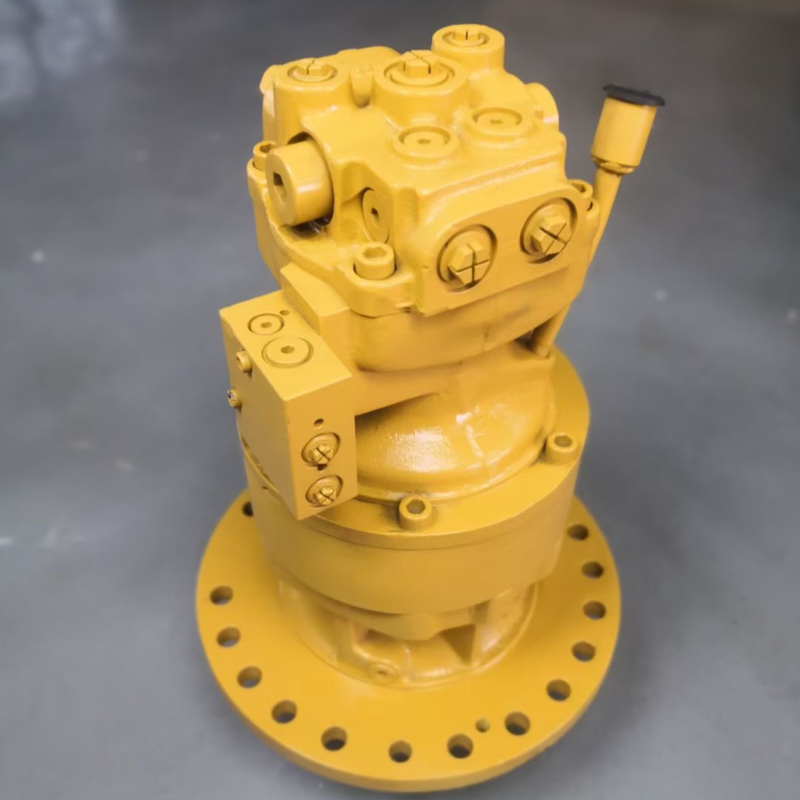
A CAT 307B swing drive problem can look deceptively simple: the upper structure hesitates, drifts, knocks, leaks or refuses to rotate, so the swing drive is blamed. In practice, the complaint can originate in the hydraulic motor, parking brake, control valve, pilot circuit, reduction gearbox, pinion, swing bearing, electrical command or contaminated oil. Replacing the most expensive assembly before separating those possibilities is a costly diagnostic shortcut.
This guide is written for workshops, fleet owners and parts buyers evaluating a CAT 307B swing drive assembly 148-1774. It explains how to identify the machine and removed unit, distinguish hydraulic and mechanical symptoms, prepare a useful RFQ, inspect a replacement before installation and commission the repaired machine without inventing model-specific settings. The Hongtengda listing is an inquiry reference, not proof that one assembly fits every 307B serial range or previous machine configuration.
What 148-1774 identifies—and what it does not prove
Hongtengda lists 148-1774 against the CAT 307B swing assembly. Caterpillar also provides a serial-aware 307B parts-diagram service and advises owners to use machine-specific parts and service information. That distinction matters. A number found on a web page, packing label or old invoice is useful evidence, but it is not a complete fitment decision.
Before approving a quotation, record the full machine PIN or serial number, arrangement information available from the machine records, every readable mark on the removed assembly, the installed orientation and all critical interfaces. A previous repair may have changed a motor, gearbox, hose, adapter or mounting arrangement. Do not assume that a unit currently installed is original merely because the machine operates.
| 证据 | What to capture | 为何重要 |
|---|---|---|
| 机器身份 | Complete CAT 307B PIN/serial, configuration and region | Separates serial breaks and machine arrangements |
| Old assembly | Tags, casting marks, stamped numbers and condition | Shows what is actually installed |
| 安装接口 | Bolt pattern, flange pilot, housing orientation and clearance | Prevents a physically incompatible shipment |
| 驱动接口 | Motor coupling, input spline, output pinion and engagement evidence | Confirms torque-transfer interfaces |
| 液压接口 | Port positions, fitting types, hose labels and drain routing | Prevents misconnection and restriction |
| Fault record | Noise, drift, response, leakage, temperature, debris and test conditions | Supports diagnosis rather than a parts guess |
How the CAT 307B swing system works
The excavator swing system converts hydraulic power into controlled rotation of the upper structure. Hydraulic flow drives the swing motor. The motor output passes through a reduction mechanism that lowers speed and multiplies torque. The output pinion meshes with the swing-bearing ring gear, rotating the house relative to the undercarriage. A holding or parking brake controls movement when swing is not commanded, while valves manage direction, acceleration, deceleration and pressure.
This chain explains why the same operator complaint can have different causes. Slow swing may be caused by inadequate hydraulic supply, internal motor leakage, brake drag or excessive mechanical resistance. Excessive coast can result from control or brake problems without damaged reduction gears. A rhythmic knock may follow ring-gear engagement rather than an internal gearbox fault. Oil at the housing may come from a seal, but the reason for seal failure could be bearing play, blocked venting, overfill, misalignment or damaged sealing surfaces.
Symptoms that justify diagnosis, not immediate replacement
Slow swing in both directions
When both directions are uniformly slow, record engine speed, oil temperature and operating mode before comparing performance. Check whether other hydraulic functions are also weak. A system-wide problem changes the diagnostic path. If other functions are normal, compare swing command, pressure response and motor leakage using the exact service procedure. Brake drag or mechanical resistance can create a similar symptom, so pressure alone does not identify the failed part.
Slow or weak swing in one direction
A directional difference points toward asymmetric valve behavior, port leakage, relief behavior, damaged passages or a load-related mechanical condition. Repeat the test with the machine safely positioned and under comparable conditions. Do not use uncontrolled side loading or a hazardous slope to create a test load.
Upper structure drifts or will not hold
Drift requires a controlled isolation strategy. Leakage through the motor, control valve or brake circuit can produce different repair scopes. External loads and machine position influence the observation. Record the boom, arm, bucket and house position, hydraulic temperature and elapsed time instead of writing only “swing drifts.”
Knocking, grinding or cyclic noise
Relate the sound to rotation angle, direction, load and temperature. A noise that repeats at the same house position may implicate gear engagement or swing-bearing geometry. A higher-frequency sound tied to motor speed may point elsewhere. Inspect lubricant condition and magnetic debris without treating one particle as a complete diagnosis. Document particle size, quantity, material appearance and where the sample was taken.
Oil leakage around the drive
Clean the area, operate only when safe and trace the first wet point. Oil can migrate along housings and fasteners. Confirm whether it is gearbox lubricant or hydraulic oil. Identify fill, drain, vent, motor and gearbox boundaries. Replacing a visible seal without checking bearing movement, surface damage, vent condition and correct fill can produce a repeat leak.
A professional diagnostic sequence
- Make the machine safe. Park on stable ground, lower attachments, isolate the machine, prevent unintended movement and release stored hydraulic energy according to the service information. Maintenance must be performed by competent personnel.
- Capture the complaint. Record who observed it, when it occurs, whether it changes hot versus cold and what work was being performed.
- Scan before disassembly. Preserve active and logged fault information, relevant monitor data and previous repair history.
- Inspect externally. Look for loose mounting, cracked brackets, damaged hoses, abnormal routing, contamination, oil migration and contact marks.
- Compare hydraulic behavior. Use approved test points and model-specific limits to compare commanded and actual response in both directions.
- Evaluate leakage and brake release. Follow the CAT service procedure. Never improvise a high-pressure connection or defeat a safety function.
- Check mechanical resistance. After safe isolation, evaluate the relevant drive, pinion and bearing interfaces using the specified procedure.
- Inspect lubricant evidence. Record level, appearance, odor, water, debris and sampling conditions.
- State the conclusion with confidence level. Separate confirmed facts, probable causes and unresolved questions.
The result should be a decision tree, not a sentence such as “swing drive bad.” For example: hydraulic supply within the applicable service range; brake release confirmed; motor leakage unacceptable under defined conditions; gearbox oil contains ferrous debris; output play exceeds the applicable service limit. Only the exact manual or verified service source should supply the limits.
Safety controls before removal
A swing-drive job combines suspended components, hydraulic pressure, stored energy, pinch points and an upper structure that must not move unexpectedly. The UK Health and Safety Executive advises that maintenance be performed by competent people, power sources be isolated, stored hydraulic energy be released and parts that could fall be mechanically supported. The machine manufacturer’s procedure remains the controlling instruction.
Plan the lift before loosening fasteners. Establish the assembly mass from verified service or shipping documentation; do not rely on an unverified web claim. Select lifting equipment and attachment points for the actual load and geometry. Mark exclusion zones, remove only the guards required for access and keep the house securely restrained. Cap hydraulic lines immediately with clean, compatible caps. Never use hands to search for a pressurized leak.
Removal evidence that improves the replacement decision
Photograph the assembly in place from several angles before disconnecting it. Label every hose and connector with durable identifiers that also appear on a sketch. Mark housing orientation and fastener positions. Record shims, spacers, dowels, brackets and transferred fittings. If a drain line is present, document its routing and condition because a restriction can damage a replacement.
After removal, protect open circuits and the component. Do not wash away diagnostic evidence before photographs and samples are taken. Compare the removed unit with the proposed replacement on a controlled bench. Use a measurement sheet rather than visual similarity alone.
CAT 307B 148-1774 RFQ checklist
A high-quality request for quotation helps the supplier reject a wrong match before freight is committed. Include the following:
- Full CAT 307B serial/PIN and clear machine-plate photograph.
- Photographs of every old-unit tag, casting and stamped number.
- Overall views showing installed orientation and hose routing.
- Mounting-face, pilot, bolt-pattern and clearance measurements.
- Input and output interface photographs and measured details.
- Hydraulic port type, size, position and labelled hose map.
- Diagnosis summary, including hydraulic, brake, leakage, noise and lubricant evidence.
- Required condition: new, remanufactured or used, stated explicitly.
- Required supplied scope: motor, reducer, valves, fittings, hardware and lubricant status.
- Destination, packing requirement, commercial terms and deadline.
Ask the supplier to repeat the decisive identifiers on the quotation and to disclose unresolved differences. The Hongtengda CAT 307B 148-1774 product page can anchor the inquiry, while the official CAT 307B parts-diagram page should be consulted with the machine serial. Hongtengda’s listing itself says application information should be confirmed before purchase.
How to compare new, remanufactured and used offers
| Offer type | Evidence to request | Main purchasing risk |
|---|---|---|
| 新件 | Traceable identity, actual-unit photos, manufacturing source, supplied scope and test evidence | Unverified interchange or undefined quality level |
| 再制造 | Core identity, replaced parts, measured surfaces, cleanliness controls and bench-test record | Cosmetic refurbishment without controlled internal restoration |
| Used | Source machine, serial marks, operating hours if documented, inspection findings and return terms | Unknown wear, contamination or storage damage |
Commercial labels are not engineering evidence. “OEM quality,” “genuine original” and “direct fit” should be supported by identity and documented scope. If the offer excludes warranty for a claimed genuine or used unit, that condition should be clear before payment. Compare total installed risk, not only purchase price: removal, installation, fluids, cleaning, freight, downtime and repeat-failure exposure can exceed the price difference between offers.
Pre-shipment evidence to request
Request current photographs of the actual unit, not only catalog images. The photo set should show all sides, tags, castings, mounting face, input interface, output pinion, ports, drain, plugs, fasteners and any impact-prone surfaces. Ask for a short video only if it demonstrates a defined inspection or bench test; rotation without measured load does not prove serviceability.
For a remanufactured assembly, request the inspection and test method, the identity of the tested unit, date, test conditions and result. For any assembly, obtain packing details that protect the pinion, flange, ports and housing from impact, moisture and contamination. Agree how discrepancies will be handled before shipment.
安装前收货检验
Quarantine the shipment until it passes receiving inspection. Match the unit to the quotation, packing list and pre-shipment photographs. Inspect for transport damage, corrosion, missing plugs, contaminated ports, damaged threads, loose fasteners and evidence that the shipped unit differs from the approved one.
Place the old and replacement assemblies in the same orientation. Compare every decisive interface and mark it pass, fail or unresolved. Do not grind, drill, weld, swap an unidentified adapter or force a coupling to make the unit fit. Modification destroys evidence and may transfer risk into the machine. Escalate any mismatch with photographs and measurements.
Installation controls that prevent repeat failure
The replacement is only one part of the repair. Correct the cause found during diagnosis. If lubricant or hydraulic contamination is present, define a system-cleaning scope from the failure evidence and service information. Inspect connected hoses, filters, cooler paths, valves and reservoirs as applicable. A new assembly installed into an unresolved contaminated circuit can fail rapidly.
Use the exact service manual for fastener condition, tightening sequence, torque, lubricant, fill level, sealant, alignment and bleeding. Verify the motor-to-reducer and pinion-to-ring-gear interfaces without inventing clearances. Route and clamp hoses as recorded before removal. Ensure hoses are not twisted, stretched, rubbing or exposed to excessive heat. Confirm that the drain path is correct and unrestricted.
Keep a clean installation record: technician, date, machine hours, replacement serial or markings, transferred parts, fluids, filters, measured interfaces and photographs. That record is essential if the machine develops a later problem.
Controlled commissioning plan
Commission in stages. Start with a static inspection, correct fill and leak check. Follow the approved procedure for priming or bleeding. Operate initially at the lowest safe demand while observing sound, leakage, temperature and response. Test both directions under comparable conditions before increasing load.
- Verify people, tools and lifting equipment are clear.
- Confirm fluid levels and all guards required for operation.
- Start and observe without a swing command.
- Apply brief, low-demand commands in both directions.
- Stop and inspect for leaks, abnormal heat, movement or noise.
- Repeat baseline tests using the same conditions recorded before repair.
- Progressively increase demand only after the preceding stage passes.
- Perform a final inspection and record results after stabilization.
Acceptance should be based on the machine-specific procedure and reproducible observations. A successful first rotation is not a complete commissioning test. Confirm holding behavior, directional consistency, stopping response, leakage, temperature trend and the absence of abnormal debris or noise.
Common purchasing and repair mistakes
- Ordering by model only. CAT 307B identifies a family, not every serial-specific interface.
- Confusing motor, reducer and complete swing assembly. Define exactly what is included.
- Using a fault code as a parts order. Codes and symptoms require circuit diagnosis.
- Copying torque or pressure values from a similar machine. Use the exact service information.
- Ignoring the drain circuit. A routing or restriction problem can damage the replacement.
- Installing into contamination. Preserve samples, identify the failure mode and clean the defined scope.
- Accepting stock photos as shipment evidence. Obtain actual-unit identity and condition photos.
- Skipping post-installation baselines. Without measurements, later warranty analysis becomes guesswork.
Decision table: diagnose, rebuild or replace?
| 发现 | 可能的下一步 |
|---|---|
| Fault evidence points outside the swing assembly | Continue system diagnosis; do not use a new assembly as a test tool |
| Identity or interface remains uncertain | Resolve serial, tags and measurements before ordering |
| Recoverable wear with competent rebuild resources and test capability | Define a measured rebuild scope and acceptance test |
| Structural damage, severe contamination or uneconomic precision wear | Compare complete replacement offers and system-cleaning cost |
| Safety cannot be controlled or service information is unavailable | Stop and escalate to qualified service support |
常见问题
Is 148-1774 guaranteed to fit every CAT 307B?
No. Treat the number as a strong inquiry identifier, then verify it with the full machine serial, official parts information, old-unit markings and physical interfaces. Previous repairs and regional or serial arrangements can matter.
Can a noisy swing system be diagnosed from a video?
A video can document the symptom, direction and operating condition, but it cannot by itself separate hydraulic, brake, reducer, pinion and bearing causes. Combine it with measured tests and inspection evidence.
Should the swing motor and gearbox be replaced together?
Only if diagnosis, supplied-scope economics or contamination evidence supports that decision. First define whether the offer is a motor, reducer or complete assembly and what valves, fittings and hardware are included.
What is the most important information for a supplier?
The complete machine serial, readable old-unit identity, clear interface photographs and a precise definition of the required scope. A symptom summary and measurements help the supplier and workshop avoid repeating the original failure.
Where should torque, oil and test-pressure values come from?
Use current service information for the exact machine and arrangement. Caterpillar’s service and parts manual resources explain how owners can access machine-specific information. Do not copy a value from a similar model or an unverified seller page.
How to read lubricant and debris evidence
Gearbox oil is evidence only when the sampling process is controlled. Record whether the machine was hot or cold, how long it had been stationary, where the sample was taken, whether the drain area was cleaned and whether the container was new and suitable. Photograph the first oil leaving the housing as well as the drained quantity when this can be done safely. Water, burnt odor, metallic sheen and visible particles each deserve investigation, but none identifies a failed component without context.
Separate large fragments from fine paste and note whether material is attracted to a magnet. Retain identifiable pieces with the job record. Compare debris with the visible condition of the pinion, bearings and internal parts if the unit is opened by a competent repair facility. A magnetic plug covered after an unknown service interval cannot be compared directly with a recently cleaned plug. Trend information from previous services is much stronger than one undocumented observation.
If an oil analysis is commissioned, provide the laboratory with the lubricant identity, service time, top-up history, sampling location and suspected failure. The report should inform the inspection plan; it should not be used to declare 148-1774 fitment or to replace the machine-specific repair procedure.
Failure analysis protects the replacement
A failed swing drive is often the last link in a longer chain. Loss of lubricant can damage bearings and gears. Bearing wear can change shaft position and damage seals. Misalignment can alter tooth contact. External contamination can enter through damaged seals or poor service practice. Hydraulic contamination or a restricted case-drain path can harm the motor and create loads that the gearbox was not intended to absorb. A loose mounting can change alignment even when the replacement itself is correct.
Write a short causal statement before installation: what failed, what evidence supports the conclusion, what underlying condition caused or accelerated it, what connected systems were checked and what corrective actions were completed. If the root cause is unresolved, state that openly and define the additional inspection. This is more useful than assigning blame to “normal wear” without measurement.
Keep the old assembly until commissioning is complete. It may be needed to compare fittings, interfaces or internal evidence. If it will be returned as a core, agree preservation, packaging and evidence requirements with the supplier before work begins.
Warehouse and transport controls for a swing drive
Storage and freight can damage a serviceable unit. Ports and openings should remain capped with suitable clean protectors. The output pinion and mounting face need rigid protection from impact. The assembly should be secured so that its mass cannot shift inside the case, and moisture protection should suit the route and expected storage period. Lifting points and center-of-gravity information should be clear enough that receiving personnel do not lift from a hose, valve or vulnerable fitting.
On arrival, photograph the unopened packaging, shock or water damage, internal restraints and the unit before cleaning. Note any loose cap, torn barrier or displaced support. If a claim may be required, preserve packaging and carrier documentation. Do not allow a damaged crate to become an undocumented workshop problem.
What a defensible acceptance report contains
The final report should connect the original complaint to the completed repair. Include machine identity, hours, before-and-after photographs, old and replacement unit markings, supplier documentation, receiving inspection, transferred components, fluids and filters, installation checks and commissioning observations. List the exact service sources used and identify the technician and instruments for any measurement.
Record the same operational points before and after repair where possible. If the original machine could not be tested safely, explain that limitation. State what passed, what remains under observation and when the first follow-up inspection should occur under the applicable maintenance plan. A clear report supports preventive maintenance, future purchasing and fair warranty review. It also prevents the next technician from repeating the entire investigation when a related symptom appears months later.
Sources and next action
This guide uses the official CAT 307B parts diagram, Caterpillar’s manual guidance and the HSE safe-maintenance guidance for general identification and safety principles. These sources do not confirm the condition or serial fitment of a Hongtengda unit.
For a written comparison, send the complete CAT 307B serial, photographs of the old drive, all markings, mounting and port interfaces, diagnosis summary, required condition and delivery destination through the 宏腾达询价页面. For broader diagnosis before ordering, review the related excavator swing motor failure guide.