An excavator hydraulic pump drive gear should be replaced only after the gear train, bearings, lubrication, alignment, and driven pump have been inspected as one system. Whine, knocking, metal in oil, irregular pump speed, or loss of hydraulic performance can involve a gear, but the root cause may be a failed bearing, damaged coupling, incorrect backlash, poor tooth contact, contaminated lubricant, misalignment, or a hydraulic pump that is loading the drive abnormally.
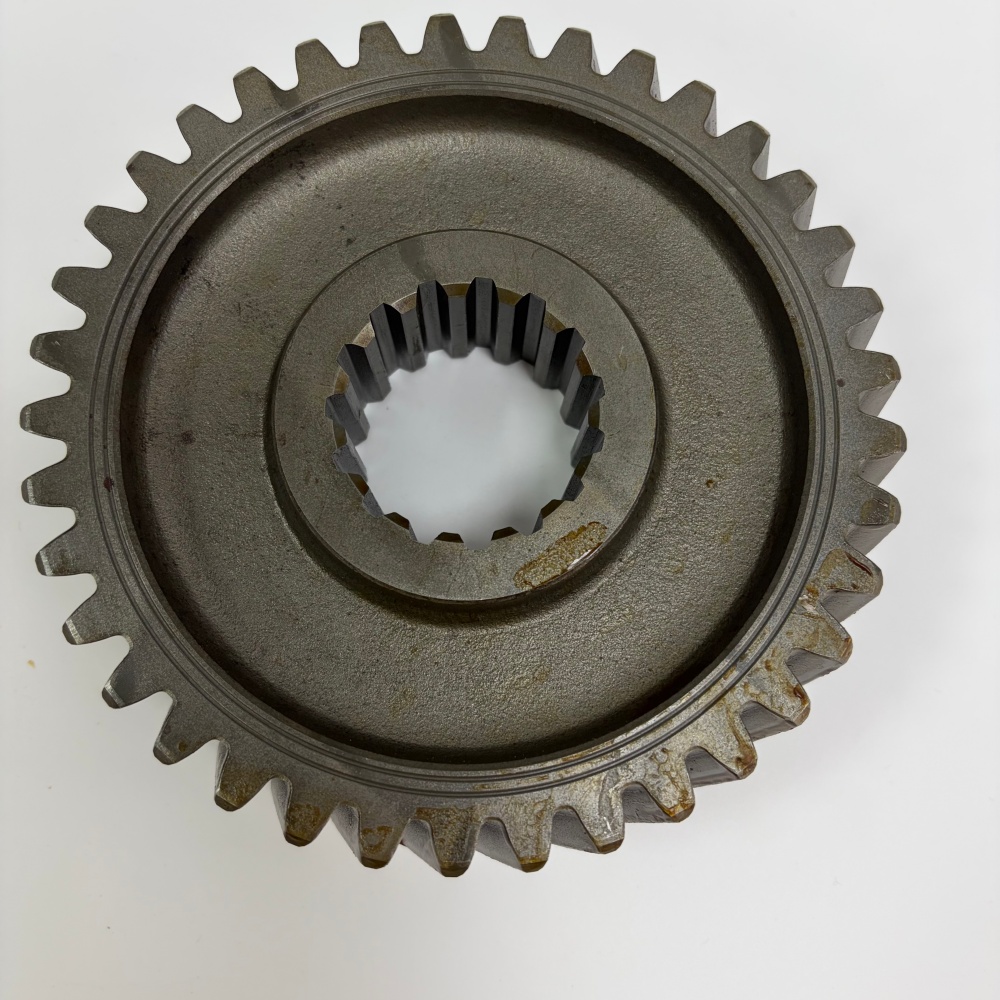
The photograph is the current catalog image for a Hitachi 3104555 hydraulic pump drive gear listing. It visibly shows an external gear form, an internally splined center, and machined contact features. The listing associates the part with several Hitachi model families, but an image, tooth count, or model list does not prove serial fitment. Confirm the official parts catalog, pump/transmission arrangement, full gear dimensions, tooth form, spline form, mating gears, and revision.
1. Separate gear-train symptoms from hydraulic symptoms
The drive gear transmits mechanical power into the pump arrangement. Gear or bearing distress can create noise, vibration, heat, and speed irregularity. Hydraulic faults can also make the drive noisy by increasing or fluctuating torque. Before opening the gear housing, record whether the complaint follows engine speed, hydraulic load, oil temperature, or a particular function.
| Observation | Gear-train possibility | Other systems to check |
|---|---|---|
| Noise follows engine speed with controls neutral | Gear mesh, bearing, coupling, or lubrication issue | Accessory drive and engine-side components |
| Noise rises mainly under hydraulic load | Tooth contact or bearing deflection under torque | Pump cavitation, control fault, relief operation |
| Metal in housing oil | Tooth, spline, or bearing damage possible | Identify particle source and material |
| Slow functions without mechanical noise | Drive slip or damage remains possible | Main pump control, leakage, engine power |
| Localized housing heat | Friction from mesh, bearing, or alignment | Oil level, viscosity, pump loading |
Hitachi Construction Machinery explains that appropriate pump-transmission oil supports smooth gear operation and helps protect against viscosity-related downtime, rust, and corrosion in applicable large excavators in its official pump transmission oil information. The specified oil and interval for the actual machine must come from its operation and service manuals.
2. Inspect lubricant, bearings, and alignment before condemning teeth
Check oil level, grade, condition, leakage, water, and debris. Record whether the oil is burnt, aerated, milky, or carrying visible particles. Retain a sample before draining. A laboratory result can identify wear metals and contamination trends, but it should be combined with visual inspection.
Inspect shafts, bearings, housing bores, retainers, and couplings. Excessive shaft movement changes tooth contact and backlash. A new gear installed over a failing bearing can develop the same edge loading or misalignment. NSK recommends monitoring abnormal noise, temperature rise, lubricant leakage, contamination, and alignment-related conditions during running inspection in its official operation inspection guidance.
3. Map tooth contact and damage patterns
Clean the gear only after documenting the original oil and debris pattern. Inspect every tooth under strong light. Mark the start point so no section is missed. Look at the drive and coast flanks, root, tip, edges, and internal splines. Photograph representative and worst areas with scale.
| Pattern | Possible contributors | Required investigation |
|---|---|---|
| Polish or wear concentrated at one face edge | Misalignment, shaft deflection, bearing movement | Housing, bearings, shaft runout, contact pattern |
| Pitting or spalling | Contact fatigue, lubrication breakdown, overload | Mating gear, oil, hardness evidence, alignment |
| Scoring or scuffing | Film loss, heat, sliding, contamination | Oil supply, temperature, debris, tooth geometry |
| Cracked or broken tooth | Shock load, fatigue, foreign object, prior damage | Fracture origin and downstream debris |
| Worn internal spline | Loose fit, misalignment, fretting, torque cycling | Mating shaft and retention condition |
SKF case material shows that gear misalignment and tooth wear can produce distinct vibration trends in rotating equipment in its official machine diagnostics paper. Vibration data can support a diagnosis, but the alarm values and sensor positions must be developed for the actual machine rather than copied from another gearbox.
4. Measure backlash and contact by the service manual
Backlash is the clearance between mating tooth flanks in the specified measuring condition. Too little clearance can reduce space for lubricant and thermal expansion; too much can increase impact and positioning error. The correct value depends on gear geometry, mounting, temperature, bearing condition, and manufacturer design.
Measure with the shafts controlled as specified, at multiple rotational positions, and with calibrated tools. Check runout, end play, center distance, bearing preload or clearance, and housing condition as the manual requires. Use marking compound only by the approved method to assess tooth contact. A centered-looking pattern is not proof if the bearings move under load.
KHK’s official gear technical reference explains how geometry and contact influence wear and lubrication. Its general formulas do not define the backlash or reuse limits for a Hitachi excavator pump drive. Do not transfer generic tables into a repair specification.
5. Decide whether the repair is one gear, a matched set, or a wider rebuild
Inspect the mating center gear, bearings, shafts, splines, coupling, housing, seals, oil passages, and driven pump. A damaged tooth transfers abnormal load to its mate. Replacing one visibly failed gear may be inappropriate if the mating profile is pitted, the bearings are loose, or contamination has circulated.
The catalog contains a separate Hitachi 3104554 center gear listing. The similar application context does not make 3104554 and 3104555 interchangeable. Each number should be matched to its defined position and mating arrangement in the serial-specific parts catalog.
A rebuild scope should list measured backlash, shaft movement, runout, tooth-contact observations, lubricant findings, bearing condition, replaced seals, cleaning method, and the reason each reused part was accepted. If the driven pump seized or generated a torque spike, correct that fault before commissioning the gear train.
6. Build an evidence-based RFQ
Send the excavator model and serial number, pump or transmission model plate, old gear part number, markings, tooth counts, internal spline count, outside and bore dimensions, face width, photographs of both faces and the edge, and images of the mating gear. State the position in the assembly and whether you require a single gear, mating set, bearings, seals, or a complete drive group.
Ask the supplier to confirm condition, manufacturer, inspection evidence, supplied scope, and identification basis in writing. Do not accept “same model” as the only match. Different serial ranges and repaired machines can contain different pump-drive arrangements.
7. Commission the repaired drive with controlled checks
Clean the housing and connected oil paths, install bearings and seals by the approved procedure, apply specified fastener methods, and fill with the correct lubricant. Prime the hydraulic pump if required. Before full load, rotate or run the assembly using the manufacturer’s staged procedure.
Monitor oil pressure where applicable, noise, vibration, leakage, housing temperature, and hydraulic response. Increase load progressively and compare the results with the baseline and manual. Stop immediately if temperature rises rapidly, noise becomes metallic, or debris reappears. Recheck oil level and inspect filters or magnetic collectors after the specified run-in period.
For a written parts comparison, send the serial plates, old gear markings, dimensions, mating-gear images, and inspection record through the Hongtengda contact page. A complete record prevents a tooth-count match from being mistaken for proven fitment.